Root cellar temperature and humidity: a harvest storage ledger
“Cool and dark” is not one storage condition. Measure the room, group crops by what they actually need, and keep damp roots, dry onions, warm squash, fruit and shelf-stable jars from working against one another.
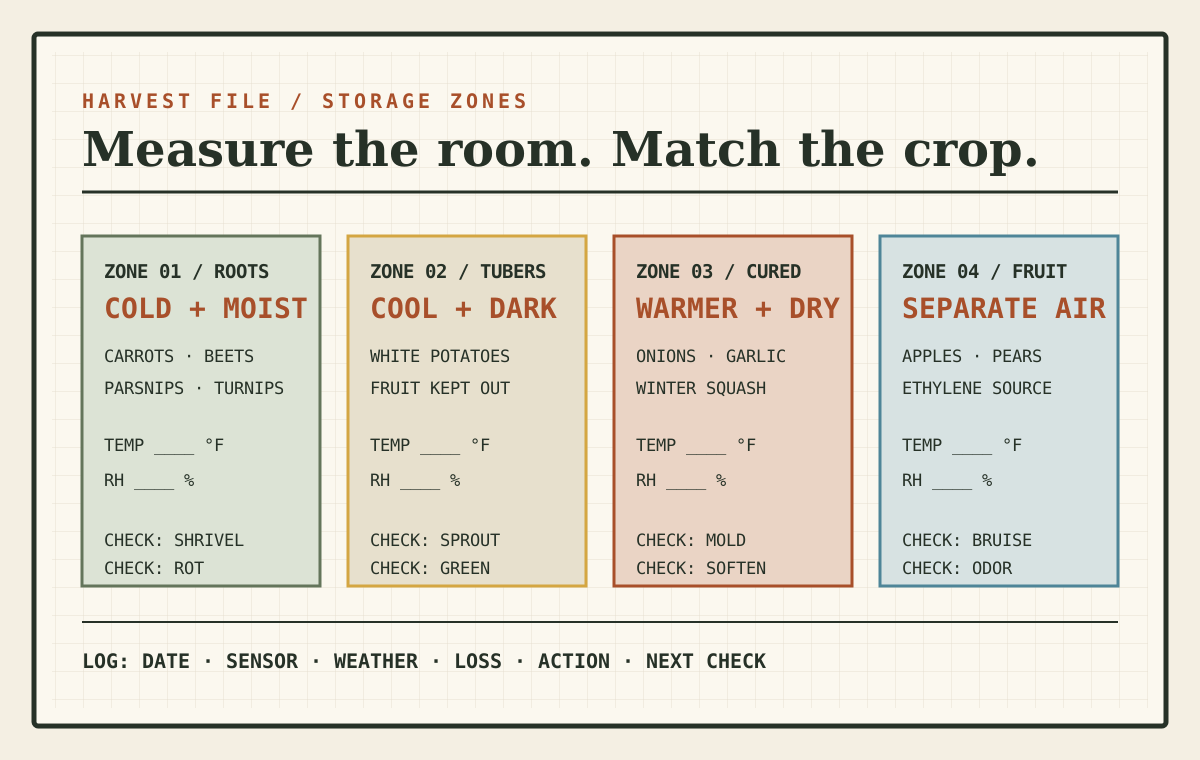
A full root cellar looks efficient, but variety can hide a conflict. Carrots lose moisture in a dry room. Cured onions and winter squash are more vulnerable in high humidity. Sweet potatoes can suffer chilling injury in conditions that suit carrots. Apples and pears release ethylene as they ripen, which can shorten the storage life of vegetables and encourage potatoes to sprout.
The practical question is not “What should a root cellar be?” It is “What temperature, relative humidity and airflow does this corner hold through the week, and which crop belongs there?” A seasonal ledger turns that question into a repeatable check.
This guide cannot evaluate a structure, drainage system, electrical installation, pesticide exposure, mold problem or spoiled food from a distance. Follow local building and fire codes, crop-specific Extension guidance and equipment instructions. Keep children and animals out of storage spaces; use safe stairs, lighting and ventilation. Do not taste suspect food. When a structure has standing water, significant mold, damaged wiring, unstable walls or poor air quality, leave it and use qualified local help.
One cellar cannot optimize every harvest
University of Alaska Fairbanks Extension groups produce into four broad storage conditions: cold and very moist, cold and moist, cool and dry, and warm and dry. University of Minnesota Extension's crop table shows why those divisions matter. Carrots are listed at 32°F and 95% relative humidity; onions at 40°F and 50%; potatoes at 40–50°F and 95%; pumpkins near 50°F and 50%; and different winter squashes near 50–54°F and 50%.
Those numbers describe optimal conditions used to protect quality. A home cellar may not hold them, and varieties, maturity, curing and damage alter storage life. Measure first. When a zone cannot meet a crop's need, reduce the amount assigned to it, use the crop sooner, or choose another safe preservation method.
| Crop group | Example Extension target | What to keep separate |
|---|---|---|
| Carrots, beets and similar roots | About 32°F and 95% RH in the UMN table | Dry onions and squash; diseased or injured roots |
| White potatoes | 40–50°F and 95% RH in the UMN table; dark storage | Light, fruit that releases ethylene, damaged tubers |
| Cured onions and garlic | Onions 40°F/50% RH; garlic 40°F/60% RH in the UMN table | High-humidity root bins and wet surfaces |
| Pumpkins and winter squash | Roughly 50–54°F and 50% RH, varying by type | Cold damp corners and ripening fruit |
| Apples and pears | Cold, moist storage; MU says separate from vegetables | Potatoes and odor-sensitive produce |
| Sweet potatoes | 60°F and 95% RH in the UMN table after curing | Cold zones below their recommended range |
Use the table as a planning prompt, not a replacement for the full source. Extension publications differ slightly because climate, crop, variety and intended use differ. Write the source and target on each crop card so the number never loses its context.
Map the empty room for seven days
Before loading bins, place calibrated or recently checked temperature-and-humidity sensors at the low, middle and high shelves. Keep them out of direct contact with exterior masonry and away from a vent, heater or door unless you are deliberately testing that microclimate. Record morning and evening readings along with outdoor temperature, rain, wind and whether vents or doors were open.
Cold air can settle low while warm air rises. A wall against soil may behave differently from an interior partition. A corner that looks dry during a sunny afternoon may collect condensation after a cold night. Seven days will not capture the whole winter, but it reveals whether the room is one zone or several.
Empty-room map / seven-day baseline
- Sensor identifier and check date
- Low, middle and high shelf readings
- Morning and evening temperature
- Morning and evening relative humidity
- Outdoor weather and frost
- Door and vent position
- Condensation, damp odor or standing water
- Light exposure and warm equipment
- Rodent or insect evidence
- Planned crop for each zone
Do not chase every short fluctuation. Look for a repeated range, the daily high and low, and surfaces that become wet. Relative humidity changes as air temperature changes, so a sudden percentage shift does not always mean water entered the room. Condensation, however, means moisture reached a surface cold enough for water to collect.
Cure, cool and sort before storage
Storage cannot improve harvest quality. UMN Extension recommends culling diseased or injured produce and notes that onions, garlic, pumpkins, winter squash, potatoes and sweet potatoes require curing. Curing conditions and duration differ by crop. Follow the crop-specific method rather than curing everything together.
Keep harvest out of direct sun and remove field heat according to the crop. Use only potable water where washing is recommended. Some crops are stored unwashed; UMN, for example, lists potatoes as washed after storage. Dry surfaces as directed before packing. Label every container with crop, variety, harvest date, curing dates, source guidance and the first-inspection date.
Sort again as produce enters storage. Set aside cuts, bruises, soft spots, open wounds and disease symptoms for prompt use or safe disposal according to Extension advice. Do not let a “use first” basket become an unnoticed source of decay inside the cellar.
Build physical separation, not just labels
Missouri Extension advises keeping fruits and vegetables apart. Apples and pears release ethylene that can reduce vegetable storage life; potatoes may sprout early near certain fruit. Strong odors from cabbage or turnips can also transfer. Separation works best when air is not freely shared: a separate room, refrigerator, insulated cabinet or vented compartment is stronger than two crates on the same shelf.
Keep cured onions, garlic, pumpkins and winter squash out of the highest-humidity root zone. Do not solve low humidity for roots by spraying water over produce or creating puddles. Use crop-appropriate packing materials and methods from Extension guidance, then track condensation and decay. Any humidification method must avoid wetting wiring, wood assemblies or stored containers.
Use washable, food-appropriate bins that permit the airflow the crop needs. Keep containers off the floor and away from walls far enough to inspect behind them. Avoid deep piles that hide crushing, heat or decay. Protect the room from rodents with screened ventilation and sound exclusion work; do not place poison, fuel, solvents, pesticides or other hazardous chemicals beside food.
Let ventilation manage heat and moisture
University of Alaska Fairbanks Extension describes ventilation as a control for both temperature and humidity: excess moisture can be exhausted, and the room aired when empty. That does not mean every vent remains fully open. Outdoor air may cool and dry the room on one day, then bring warm damp air on another.
Record inlet and outlet positions with the sensor readings. Change one setting at a time and observe the next comparable weather period. Screens must exclude rodents without becoming clogged. Drainage must keep surface and groundwater out; ventilation cannot repair a leak. In attached storage, uncontrolled moisture can damage the rest of the building, so vapor and insulation decisions belong with a qualified local building professional.
Keep canned and dried food in a dry pantry
A damp root-cellar zone is not a general pantry. The National Center for Home Food Preservation recommends storing home-canned jars in a clean, cool, dark, dry place, preferably 50–70°F. Dampness can corrode lids, break seals and allow recontamination. NCHFP also recommends storing jars without ring bands after seals are checked and jars are cleaned and dried, because this makes seal failure easier to detect.
Keep dried foods cool, dry and dark in clean, moisture-resistant containers. Do not put paper labels, metal lids, cardboard or dry staples into a condensing vegetable zone. Link the separate pantry to the outage dependency map so refrigeration-dependent crops, ventilation fans and alarms have a written failure plan.
Run a weekly loss walk
- Read each sensor before opening doors or changing vents.
- Record high and low values if the instrument stores them.
- Inspect ceiling, walls, floor and containers for condensation, frost, leaks or mold.
- Check one layer at a time for softening, shriveling, sprouting, chilling injury, odor or pests.
- Remove affected produce without carrying debris across clean bins.
- Record the crop, quantity, location, symptom and action. Never hide a loss by changing only the inventory total.
- Clean the area with a crop- and surface-appropriate method, then wash hands and tools.
- Change one controllable factor and schedule the next check.
UMN warns that one diseased onion or potato can spread a pathogen through a bin and recommends periodic culling. A loss record turns failure into next year's decision: store less of that variety, improve curing, change the container, use the warm shelf first, or choose a different zone.
Use action thresholds instead of wishful shelf life
| Signal | Immediate action | Ledger question |
|---|---|---|
| Temperature outside the crop target | Move the crop to a safer verified zone or plan earlier use. | Was the change weather, door position, load or equipment? |
| Condensation or visible water | Protect food from direct wetting; locate leak or airflow cause. | Which surface, time and outdoor condition repeat? |
| Sprouting or rapid softening | Separate affected items and reassess temperature, light and fruit proximity. | Did the crop start cured and sound? |
| Mold, rot or pest evidence | Isolate affected food; do not taste; clean and seek Extension help when unsure. | Which bin and neighboring lots are exposed? |
| Home-canned seal failure, leakage or bulging | Do not taste. Follow NCHFP instructions for suspect jars. | Was the dry-pantry rule broken? |
Published shelf-life estimates assume ideal conditions and sound produce. The actual food, room and readings decide what happens next. When safety is uncertain, discard according to authoritative guidance rather than relying on smell or a taste.
Hand off the cellar in one page
A second person should be able to run the storage week without oral history. Post a map with zones, sensor locations, vent settings, crop cards, inspection day and the contact for local Extension help. Include the coldest acceptable reading, the warmest acceptable reading and the action for each crop. Mark stairs, switches, exits and hazards on the farm emergency map.
Finish the season by comparing starting weight or count, food used, food lost, dates and labor. The goal is not a cellar with no losses. It is a system that finds problems early, matches crops to measured conditions and makes the next harvest easier to store.
Questions from the storage bench
What temperature and humidity should a root cellar be?
There is no single target for every crop. Many roots prefer cold, very moist storage, while cured onions and winter squash need drier conditions and sweet potatoes need warmer storage. Measure the space and match crops to current Extension guidance.
Can apples and potatoes share a root cellar?
Extension guidance recommends separating fruit from vegetables. Ripening fruit releases ethylene that can shorten vegetable storage life and promote potato sprouting.
Should home-canned jars be stored in a damp root cellar?
No. NCHFP recommends a clean, cool, dark and dry place, preferably 50–70°F. Dampness can corrode lids, break seals and permit recontamination.
Sources
Reviewed October 22, 2026. Crop variety, harvest maturity, curing, local climate, structure and measured conditions change storage performance.
- University of Minnesota Extension — Postharvest Handling of Fruit and Vegetable Crops in Minnesota (reviewed 2026).
- University of Alaska Fairbanks Cooperative Extension — Vegetable Storage in Root Cellars.
- University of Missouri Extension — Home Storage of Fruits and Vegetables in Root Cellars (reviewed January 2023).
- Penn State Extension — Keeping Produce Fresh: Best Practices for Producers.
- National Center for Home Food Preservation — Storing Home Canned Foods.
- National Center for Home Food Preservation — Packaging and Storing Dried Foods.